
Introduction
Podcasting today is more than a content format.
It’s a growing opportunity to shape conversations, build authority, and reach audiences who prefer insightful conversations and perspectives.
But producing a podcast that actually delivers impact and aligns with your business goals requires a lot more than hitting “record.” You need clarity of purpose, thoughtful show design, strong production practices, disciplined post-production, and a distribution plan that gives every episode a life beyond the feed.
That’s why we decided to share our guide on podcast production. This guide walks you through the enterprise podcast production process, so you can understand what it really takes to create a high-quality, scalable podcast for your brand.
Whether you plan to build internally or with a podcast production partner, this guide gives you the foundation to produce a show that supports your brand, your audience, and your long-term goals.
Key Stages of Podcast Production: How To Produce A High-Quality Podcast
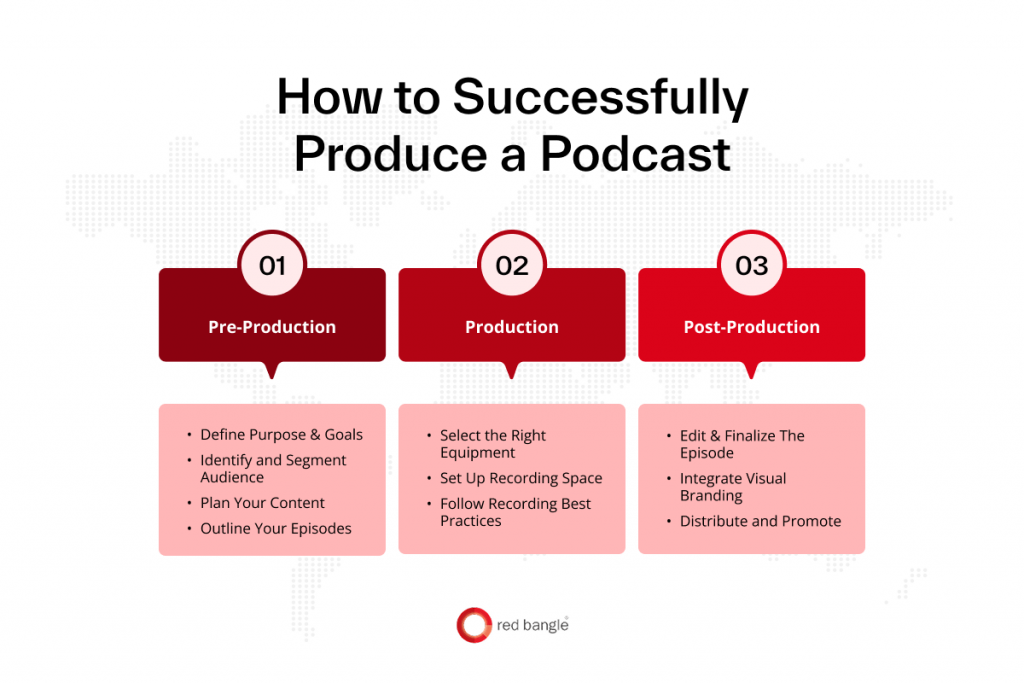
Podcast production is the end-to-end process of conceptualizing, researching, designing, planning, recording, editing, and packaging content at regular intervals for audio and video channels. It covers equipment setup, studio or remote recording, mixing, mastering, and show notes or transcripts for podcast SEO.
Brands use podcast production services to launch professional episodes on platforms like Spotify, Apple Podcasts, and YouTube. A clear podcast production workflow improves quality, saves time, and turns each episode into a consistent volume of high-quality marketing content.
With that in mind, here’s the full production workflow you can follow for producing a high-quality podcast:
Stage 1: Pre-Production: Strategy, Format, and Planning
Pre-production is the foundation of a successful podcast. This is where you establish the strategic direction for your content and ensure that your podcast aligns with your brand goals. This stage is critical because it sets the tone for the entire series and ensures alignment with broader marketing goals.
Key Steps of Pre-Production:
Define the Purpose and Goals of Your Podcast
Before you record anything, you need to clearly define why your business is creating a podcast. The purpose of your podcast should align with your overall marketing strategy to ensure every episode has a clear objective and value proposition.
Here are the questions you must ask at this stage:
- Who is the audience, and what is a challenge they would like to learn how to solve?
- Which are the platforms that this audience listens to/watches podcasts on?
- What are the goals to achieve with this podcast in terms of reach and engagement?
Example: If you’re a SaaS company, the goal of your podcast might be to educate potential customers on how to solve pain points using your platform, while subtly highlighting your product’s capabilities.
Identify and Segment your Target Audience
Understanding who your podcast is for is crucial. Are you targeting decision-makers, industry professionals, or a niche group of customers? Developing audience personas allows you to tailor the content specifically to their needs, challenges, and interests, and helps shape the tone of your podcast.
- Example: A B2B marketing podcast might target marketing heads at mid-sized businesses, focusing on advanced digital marketing strategies to help them scale their operations.
Create a Content Strategy and Editorial Calendar
Planning your podcast’s content is vital to ensure it aligns with your business goals and keeps your audience engaged.
Determine the format of your podcast. Decide on whether you’ll do interviews, deep dives into specific topics, or roundtable discussions. Then outline the key topics for the first 10–12 episodes. A well-planned editorial calendar helps you stay organized and consistent in your content delivery.
- Pro tip: Align your episodes with your marketing calendar. For instance, if you’re launching a new product, schedule podcast episodes that discuss features and use cases leading up to the launch.
Script or Outline Your Episodes
While some podcasts thrive on spontaneity, business podcasts often benefit from a bit of structure. Having an outline for each episode ensures the discussion stays on track and the content is clear and concise. You don’t need a full script, but a bullet-point outline with key discussion points can keep the episode focused.
- Example: For a product-focused episode, your outline might include an introduction, a brief overview of the product, a deep dive into features and benefits, and a concluding CTA directing listeners to a landing page for more information.
Other Elements of Pre-Production
- Plan the visual elements like episode titles, branded intros and outros, and graphics that align with your brand’s identity.
- Decide in advance what graphics will be used for promoting the episode on social media platforms.
- Choose guests who align with your brand values and can offer valuable insights.
- Ensure your podcast is part of your larger content marketing strategy. Integrate it with your SEO efforts and distribution channels to maximize reach.
Stage 2: Production: Recording A High Quality Podcast
Once the strategy is established, the next stage in the podcast production process is recording. At this stage, the bulk of the work takes place, and it is critical to focus on both audio and video quality. The quality of this stage directly impacts the professionalism and credibility your brand will project to your audience.
Key Production Decisions:
Invest in Good Recording Equipment
Good equipment is non-negotiable when it comes to business podcasting. You don’t need the most expensive gear. But you should invest in quality microphones and audio interfaces to ensure your recordings sound crisp and professional.
- Recording tools to consider:
- USB microphones like the Blue Yeti are excellent for those with minimal setup space. They’re easy to use, affordable, and provide good quality sound.
- For a more professional setup, consider the Shure SM7B (XLR mic) paired with an Audio Interface like the Focusrite Scarlett 2i2. This setup provides superior audio quality, especially for interviews and group discussions.
Create a Quiet Recording Environment
Minimize background noise by recording in a quiet space. If your office environment isn’t ideal, you can use portable soundproofing tools to help reduce distractions. Pay attention to background, lighting, and other visual elements that will affect the overall look.
- Pro Tip: For remote interviews, ask guests to record in a quiet space using headphones to avoid feedback and ensure clear audio.
Follow Best Recording Practices
Avoid excessive pauses, background noise, or speaking too close to the mic. Keeping a steady distance from the microphone and ensuring the right microphone gain levels will make a significant difference.
- Pro tip: Use headphones like the Sony MDR-7506 to monitor audio levels in real-time and ensure consistent sound quality throughout the recording.
If you’re working with a distributed team or recording across locations, partnering with production partners like Red Bangle can help you streamline setup, technical checks, and on-ground/remote direction, ensuring every episode feels consistent and professional.
Stage 3: Post-Production: Editing, Distribution, Promotion
After recording, the next step is post-production. This phase is where your podcast is polished and refined, ensuring that the final product aligns with your brand’s quality standards and is ready for distribution. This step involves removing mistakes, improving sound quality, and ensuring your podcast sounds smooth and professional.
Key Steps in Post Production
Editing and Enhancing the Full Episode:
In this stage, the audio is meticulously cleaned up to remove any filler words, background noise, and long pauses. The episode is then fine-tuned to ensure a smooth flow, making it engaging and easy for listeners to follow. Intro and outro music, along with any sound effects, are seamlessly added, aligning the content with the brand’s tone and message.
- For example: Use editing software like Adobe Audition for precise cuts, or Descript for an AI-assisted, text-based approach to editing, making it faster and easier to remove unwanted content.
Tools like Adobe Podcast AI and Auphonic can also help automatically reduce background noise, balance audio levels, and improve overall sound quality, especially when recordings come from different environments. You can also outsource editing your podcast to a reliable podcast production agency.
Integrating Graphics and Visual Branding
During the editing process, branding visuals such as lower-thirds, episode titles, and logos are incorporated into the content. Captions are added where necessary to enhance accessibility and engagement, particularly on platforms where videos may be viewed without sound.
- For example, at Red Bangle, we ensure that every podcast we produce features tailored, branded intros and outros, along with customized graphics that align with your brand’s visual identity.
Distribution and SEO Optimization
In this phase, the podcast is uploaded to distribution platforms like Spotify and Apple Podcasts. Metadata such as titles, descriptions, and tags are optimized for discoverability. Additionally, show notes, timestamps, and transcripts are added to enhance SEO and make your rank higher in search results.
- Pro Tip: Tools like Buzzsprout and Libsyn allow easy management of podcast episodes while automatically submitting your content to multiple platforms. Also, don’t forget to cross-promote your episodes on social media to boost discoverability.
Promoting Your Podcast
After your podcast is distributed across platforms like Spotify, Apple Podcasts, and YouTube, it’s time to amplify its reach. This involves leveraging social media channels, email newsletters, and other digital platforms to share your episodes, snippets, and highlights.
- For example, sharing podcast episodes about a new product launch, alongside paid ads or email campaigns, can create a seamless experience for your audience and boost both engagement and conversions.
Now, let’s explore the types of podcasts you can produce to represent your business.
Types of Podcasts You Can Produce For Your Business
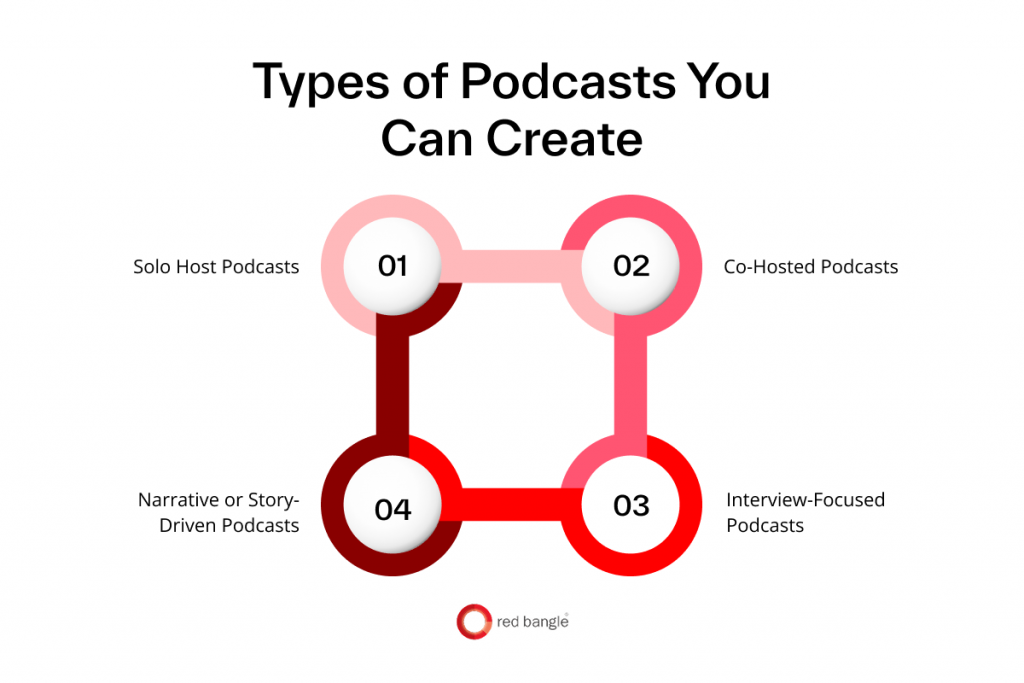
When it comes to producing a podcast for your business, choosing the right format is essential for aligning with your brand’s voice, audience expectations, and long-term goals. Different formats offer unique benefits, and the one you choose will dictate the type of content you create and how effectively you can engage your audience.
Here’s an overview of podcast formats that are especially relevant for businesses and brands:
1. Solo Hosts Podcasts
Solo hosts or solo commentary podcasts work best when you want to position your leaders as credible industry experts. This format allows a single person, often a founder, CXO, or subject-matter expert, to lead the conversation, offering unique insights, expert opinions, and deep knowledge about a specific industry or topic.
If you want to establish yourself or your leadership team as an industry expert, a solo commentary podcast is an ideal choice. With no co-hosts or guests to coordinate, you can maintain a consistent publishing schedule with minimal production effort.
2. Co-Hosted Podcasts
Co-hosted podcasts introduce multiple voices to the conversation, which can add depth and balance. Featuring two or more hosts, this format is perfect when you want to highlight diverse perspectives or showcase a team effort within your business.
However, managing a co-hosted show does require some coordination. With multiple hosts, scheduling can become more complicated. So clearly define everyone’s role to ensure a smooth, focused conversation.
3. Interview-Focused Podcasts
An interview-focused podcast can help elevate your brand’s credibility by featuring industry experts, influencers, or thought leaders.
When you invite guests onto your podcast, you bring new voices, stories, and expertise to your audience. This not only enriches your content but also boosts your credibility by associating your brand with established industry names.
A good example for this approach is our interview with InMobi founder, produced for Belong.co. The conversation blends storytelling with strategic insight, showing how an interview format can create the kind of depth that listeners value.
4. Narrative or Story-Driven Podcasts
Narrative podcasts are an excellent way to engage your audience on a deeper, more emotional level.
By crafting a story, whether it’s about your brand’s journey, customer success stories, or an investigative series, you can draw listeners in and create a lasting connection. This format allows you to structure your podcast like an audio documentary, combining scripted segments, interviews, and sound design to create an immersive experience.
Now that you’ve considered the formats that suit your brand, let’s dive into the next critical element: the costs involved in podcast production. Understanding these costs upfront will help you plan more effectively and avoid unnecessary expenses as you move forward with your podcasting journey.
Before You Start: How Much Does Podcast Production Cost
Your podcast budget will vary depending on whether you are producing audio-only episodes, incorporating video, or scaling a setup that multiple team members will use. The goal is to build a reliable foundation that supports quality and consistency rather than chasing expensive gear for its own sake.
1. Breakdown of Podcast Production Cost by Stage
Here’s a breakdown of how your budget typically gets allocated across the podcast lifecycle:
| Stage | Activities | Cost Drivers | Typical Investment Range |
| Pre-production | Planning, scripting, and guest outreach | Research, scriptwriting, and guest fees | $200–$2,000 per episode |
| Production | Recording (audio/video), equipment rental | Microphones, studio time, software | $500–$5,000 per episode |
| Post-production | Editing, sound design, mixing | Editing software, sound engineer | $200–$2,000 per episode |
| Distribution | Uploading, SEO, promotion | Hosting, marketing | $100–$1,000 per episode |
This cost breakdown will vary depending on your podcast’s format, the resources you invest in, and the scale of your production.
For instance, a podcast with high production values, guest interviews, and frequent episodes will cost more than a simple solo-host podcast. Similarly, if you’re focusing on high-quality audio and video, expect to spend more on equipment and editing.
2. In-House vs Outsourced Podcast Production Costs
Managing production internally can be cost-effective if you already have a team with the skills required. However, outsourcing can provide access to specialized expertise, ensuring a high-quality podcast that aligns with your business’s standards and goals.
When planning your budget, consider both one-time purchases and ongoing costs. Here are a few questions to ask at this stage:
- How much time can your team dedicate to production each week?
- Which tasks should remain internal, and which should be outsourced?
- What level of quality does your audience expect?
- How will the podcast contribute to business outcomes such as lead generation, brand equity, or customer education?
For many businesses, outsourcing to an experienced podcast production agency like Red Bangle can be a strategic decision. Partnering with experts ensures a seamless process, from planning to distribution, without the operational overhead.
With a dedicated team handling editing, sound design, guest coordination, and SEO optimization, you can focus on content creation and strategic goals, while experts handle the technical side. Outsourcing also offers scalability, allowing you to expand your podcast’s reach without stretching internal resources.
Conclusion: Ready to Craft Your Podcast?
You’ve now explored what it truly takes to produce a podcast that resonates with your target audience.
When all these stages and elements align, a podcast becomes far more than a marketing asset. It becomes a platform for shaping conversations that matter, building trust with the audiences who influence your growth, and positioning your brand as a steady voice in your industry.
However, to fully realize the benefits of podcasting, you must approach it with a strategic mindset. Focus on systems that will ensure consistency and scalability rather than individual episodes.
If you’d like a partner in that journey, Red Bangle can simplify the complexity of podcast production for you. We understand the intricacies of creating a successful podcast. Our team brings together podcast strategy, production, design, and multi-channel distribution, ensuring your podcast speaks directly to your audience.
The only question now is: what story do you want to tell next?
Book a call now and streamline your podcast production. Partner with Red Bangle to bring your podcast vision to life.
Leave a Reply